
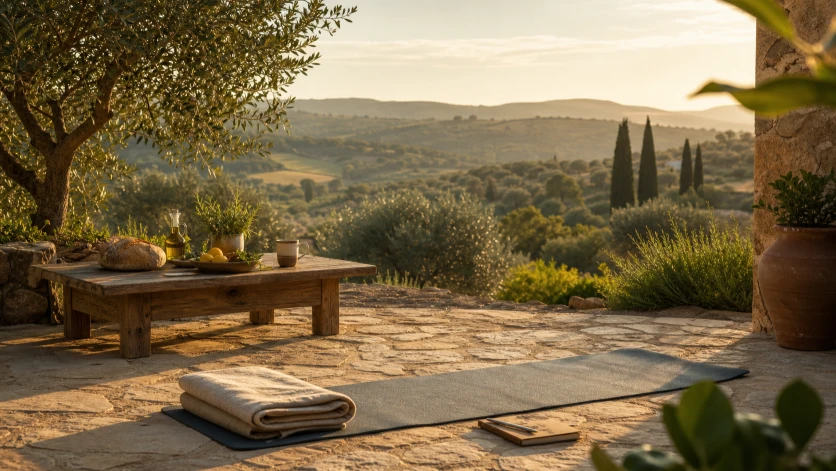
If you are searching for a yoga retreat in Sicily, you will find beautiful photos very quickly.
Sea views. Terraces. Linen clothes. A woman doing downward dog in front of an infinity pool. I understand the appeal. Sicily is generous with beauty, and yes, a good view does help you breathe a little deeper.
But a yoga retreat is not a photo. It is a week of your life. It is where you sleep, who teaches you, what you eat, how much space you have, and whether the place around you feels alive or simply decorated for visitors.
So before you choose a wellness retreat in Sicily, I want to give you the questions I would ask. Not as a hotel inspector. As a palermitana who knows the difference between real hospitality and a pretty package.
Start with the place, not the pose
Here is the first thing I look at: where does the retreat actually happen?
Not just “Sicily.” Sicily is not one mood. Palermo is loud, layered, full of markets and scooters and salt air. The Nebrodi mountains are green, quiet, and full of olive trees. The southeast is baroque towns and dry stone walls. The islands feel completely different again.
If a retreat could be moved from Sicily to Portugal or Greece without changing anything except the menu, be careful. That usually means the place is being used as a background, not as part of the experience.
A real yoga retreat in Sicily should let Sicily enter the day. Maybe through the food. Maybe through the landscape. Maybe through a visit to a small village, a market, an olive grove, a family kitchen. It does not need to be busy. Actually, it should not be too busy. But it should have roots.
Ask yourself: will I feel where I am, or will I only feel that I am away?
That difference matters.
Resort comfort is not the same as retreat depth
I have nothing against comfortable hotels. Believe me, after a long day in Palermo in August, good air conditioning feels like a blessing.
But a retreat is different from a resort holiday. A resort often protects you from the place. A retreat, the good kind, helps you meet it slowly.
This does not mean you should accept uncomfortable rooms or disorganized hosting. Basic comfort matters. You need to sleep well. You need clean spaces, good food, shade, water, and clear answers.
But be careful with retreats that sell only luxury. If every sentence is about the pool, the linens, the spa, and the view, I would ask what happens beyond that. Who is cooking? Is the food Sicilian or just “Mediterranean” in that vague way? Are you meeting anyone local? Is the schedule designed around the natural rhythm of the place, or around filling a brochure?
The best retreats I know have comfort, but they also have character. A kitchen that smells of tomatoes and olive oil. A terrace where people stay after dinner because the conversation has softened. A morning silence that feels natural, not imposed.
Look carefully at the daily rhythm
Some people want a strong yoga program. Two practices a day, workshops, deep study, a lot of time on the mat. That can be wonderful if that is what you are looking for.
Other people want yoga as part of a slower, more nourishing week. Morning movement, restorative sessions, time to rest, good meals, a walk, a swim, maybe a cooking class. Also wonderful.
The problem is when a retreat is not honest about its rhythm.
Before booking, read the schedule with your real body in mind. Not your fantasy vacation body. Your actual body after travel, after work stress, after a flight, after months of too many emails.
Does the day have pauses? Are meals rushed? Are excursions optional? If yoga is early, how early?
A retreat should give you structure without trapping you. You want to feel held, not managed.
A Momento Patrizia
Years ago, I hosted a guest who arrived in Sicily with a notebook full of things she wanted to “achieve” during her holiday. Better yoga, better sleep, better eating, better everything. On the second day, she missed an afternoon activity because she fell asleep under an olive tree.
She apologized to me later, as if she had failed. I told her, “Maybe that was the retreat.” Sometimes your body understands the itinerary before your mind does.
That is still one of my measures for a good retreat: does it leave enough space for the thing you did not plan?
Ask who is teaching, not only what style
Vinyasa, Hatha, Yin, restorative, meditation. These words help, but they do not tell the whole story.
The teacher matters more than the label.
A good retreat teacher knows how to read a room. They understand that guests arrive with different bodies, different experience levels, and different reasons for being there. Some people want challenge. Some people are nervous. Some are grieving something. Some simply need to move after a year at a desk.
Ask about the teacher’s approach. Is the practice accessible to beginners? Are modifications offered? Can experienced students find depth without beginners feeling lost?
I always like teachers who take the work seriously without taking themselves too seriously. Yoga in Sicily should not feel like a performance. You are not there to impress the person next to you. You are there to return to yourself a little.
That sounds grand, I know. But sometimes it is very simple. You breathe. You stretch. You stop clenching your jaw. Then you have breakfast.
Food is not a detail on a wellness retreat in Sicily
Please do not treat food as a small line at the bottom of the retreat page. In Sicily, food is never a detail.
If you are coming here for a wellness retreat, ask what “wellness” means at the table. Is it restrictive, or is it nourishing? Is the menu local and seasonal? Will you taste Sicilian ingredients, or will you eat the same smoothie bowl you could find anywhere?
I am biased, of course. Food is one of the most honest ways to understand a place. A good Sicilian meal tells you about the land, the season, the family, the history. Fava beans in spring. Tomatoes in summer. Wild fennel. Ricotta that still tastes of the countryside.
Wellness does not need to mean tiny portions and sad lettuce. Not here.
In Sicily, a nourishing table might be grilled vegetables with good olive oil, handmade pasta with a simple sauce, local fish, citrus, almonds, herbs, warm bread, and wine if you want it. It is balance, not punishment.
If the retreat includes cooking, even better. A yoga and cooking retreat in Italy can work beautifully when both parts are real. Yoga brings you into your body. Cooking brings you into your hands. Together, they slow you down in a way that feels natural, not forced.
Small group or big group?
There is no perfect number for everyone, but group size changes everything.
A large retreat can have energy. You meet many people. But it can also feel anonymous, especially if you came because you wanted quiet or personal attention.
A small retreat feels more intimate. The teacher can learn your name. The host notices if you do not eat eggplant. Conversations at dinner become easier because you are not shouting across a banquet table.
For Sicily, I prefer small. This island opens best through closeness: a small kitchen, a small village, a table where people pass plates instead of lining up at a buffet.
Ask how many guests there will be, whether meals are shared, and whether the host is present. These details tell you what kind of week you are really booking.
Check the balance between retreat and tourism
Sicily has so much to see that retreat organizers sometimes make one mistake: they try to include everything.
If you want a sightseeing holiday, take one. There is nothing wrong with that. But do not call it a retreat if every day is packed from breakfast to bedtime.
A good wellness retreat in Sicily should choose carefully. One village visit that has meaning is better than three rushed stops. One slow cooking afternoon is better than watching someone demonstrate five dishes while everyone takes photos. One free afternoon by the pool may be exactly what lets the rest of the week settle into your body.
The question is not “how much is included?” The better question is “why is this included?”
Every activity should support the feeling of the retreat. If it does not, it is noise.
Read the language for honesty
You can learn a lot from the words a retreat uses.
I get suspicious when everything is described as magical, life-changing, exclusive, or unforgettable. Maybe it will be wonderful. But those words are easy. They do not tell you anything practical.
Look for specific language. Where exactly is the retreat? Who is teaching? Who is hosting? What kind of yoga? What kind of meals? How much free time? What is not included? What happens if the weather changes? Is transport clear? Are dietary needs handled with care?
Honest retreat pages do not hide the edges. They tell you if the setting is rural. They tell you if you need a car or if transfers are arranged. They tell you if rooms are simple. They tell you if the yoga is gentle, not advanced. They tell you who the retreat is not for.
That last part is important. A retreat that tries to be perfect for everyone usually becomes meaningful for no one.
Questions to ask before you book a yoga retreat in Sicily
Before you send a deposit, ask a few direct questions. A good host will not be annoyed. Actually, they should be glad you care.
Where exactly is the retreat, and what is nearby? Sicily can be rural, urban, coastal, mountainous, or remote.
Who teaches the yoga, and what is their style? Ask about beginners, modifications, injuries, and the balance between active and restorative practice.
How many guests will be there? This affects everything from yoga attention to dinner conversation.
Who prepares the food? Local cooking and outsourced catering are not the same experience.
How much free time is built into the schedule? If the answer is “not much,” it may be more of a tour than a retreat.
Are activities optional? Your energy may change during the week. A retreat should allow for that.
What does the price include and exclude? You do not need surprises about transport, drinks, excursions, or extra services.
What happens if I am new to yoga? The answer should make you feel calmer, not embarrassed.
When yoga and Sicily really meet
For me, the most beautiful retreat moments are rarely the official ones.
They happen when someone rolls up their mat and stays quiet because the morning light is still on the hills. Or when a group that met two days earlier starts laughing together while kneading dough.
This is when yoga and Sicily meet properly. Not in the marketing. In the body.
The island helps because it is physical. The heat, the salt, the stone streets, the mountains, the food. Sicily pulls you back into your senses.
That is why a yoga retreat here can be so powerful when it is done with care. You practice presence on the mat, then Sicily keeps asking you to practice it everywhere else.
My honest advice
Choose the retreat that feels specific.
Specific place. Specific people. Specific food. Specific rhythm. Specific reason for being in Sicily.
Do not choose only the most polished photos. Do not choose the longest list of inclusions. Do not choose the retreat that promises to transform your whole life in five days. Maybe your life does not need transforming. Maybe it just needs a week where you sleep deeply, eat real food, move gently, and remember what quiet feels like.
That is already a lot.
If you are curious about how I bring yoga, cooking, and countryside together, you can read about my Sicily yoga and culinary retreat. I keep the details there, because this guide is here to help you choose well, whether you come with me or not.
And if you know that the cooking part is what calls you most, you might also like the slower rhythm of a week-long cooking class and country house stay or a simple olive oil and wine tasting in Palermo.
Whatever you choose, ask for the real thing. Sicily is too alive to be used as a backdrop.