
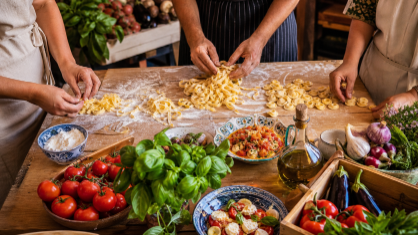
If you are planning a food experience in Palermo, you will probably face this question: should you book a cooking class or a food tour?
Both can be wonderful. Both can be a waste of time if you choose the wrong one for the kind of traveler you are.
A food tour gives you Palermo outside: markets, streets, vendors, noise, fried things eaten with your hands. A cooking class gives you Palermo inside: ingredients, techniques, recipes, a kitchen, a table, and time to ask questions.
So the answer is not “which is better?” The answer is “what do you want to feel at the end?”
Let me help you choose honestly.
Choose a food tour if you want the city first
A food tour is the right choice if you want to understand Palermo through its streets.
You walk. You taste. You hear the market voices. You see the old center in motion. You learn why panelle are everywhere, why we say arancine in Palermo, why a simple piece of sfincione carries history, and why some foods look strange until someone explains them.
This is especially good if you have limited time. In a few hours, a good food tour can introduce you to several neighborhoods, many bites, and the logic of local eating. You do not need to research every stall or worry about ordering in Italian. Someone local handles the rhythm.
It is also good if you like movement. Food tours are social and energetic. You are not sitting in one place. You are letting Palermo come at you.
Choose a food tour if your question is: “What should I eat in Palermo, and where does it come from?”
Choose a cooking class if you want the kitchen first
A cooking class is the right choice if you want to learn with your hands.
You are not only tasting Sicilian food. You are making it. You see how the dough should feel, how the sauce changes as it cooks, how much salt is enough, how a recipe becomes less mysterious when someone stands beside you and says, “Now look at the texture.”
This matters because Sicilian cooking is practical. It is not about decoration. It is about knowing when eggplant has fried enough, when pasta dough needs more water, when breadcrumbs should replace cheese, when a market ingredient should change the plan.
A cooking class gives you skills you can bring home. Maybe you will not recreate Palermo exactly in your kitchen, but your hands remember more than your camera does.
Choose a cooking class if your question is: “How can I cook this myself, and understand why it works?”
The biggest difference: tasting vs doing
This is the simplest way to decide.
On a food tour, you taste many things. The variety is the point. You build a map of flavors: fried, salty, sweet, sour, smoky, fresh, strong. You learn by moving from one bite to the next.
In a cooking class, you go deeper into fewer things. You may make pasta, caponata, arancine, a sauce, a dessert, or another seasonal menu. You learn by repeating, touching, adjusting, tasting again.
Neither is superficial if done well. They just teach differently.
I think of a food tour as opening the door. I think of a cooking class as entering the house.
If this is your first day in Palermo
If it is your first day in Palermo, I often recommend a food tour.
Not always, but often.
The reason is simple: a food tour helps you understand the city quickly. You learn the markets, the street food, the neighborhoods, and the basic rules of eating here. After that, the rest of your trip becomes easier.
You will know what panelle are when you see them again. You will understand why breakfast is small but street food is serious. You will recognize a busy stall that locals trust. You will feel less like Palermo is shouting at you in a language you do not understand.
If you are nervous about Palermo, a guided food tour can also soften the city. The market feels less chaotic when someone explains the chaos.
If you have already walked the markets
If you have already explored Palermo and tasted the street food, book the cooking class.
That is when the questions usually begin. What is in the filling? Why does this sauce taste sweet and sour? How do you shape pasta without a machine? Why does the same eggplant taste better here than at home?
A cooking class answers those questions in a way eating alone cannot.
It also gives you a slower experience. After a few days of walking, sightseeing, and restaurants, standing in a kitchen can feel grounding. You stop consuming Palermo and start participating a little.
This is the moment I love most: when a guest stops asking “Is this authentic?” and starts asking “Can I try?”
A Momento Patrizia
Once, during a cooking class, a guest told me she had eaten caponata three times in Palermo and did not understand why mine tasted different. I handed her the spoon and made her taste the eggplant before it met the celery, then the sauce before the vinegar softened, then the finished dish after it rested.
She looked at me and said, “Oh. It is not one flavor. It is timing.” Exactly. Some things you only understand when you cook them.
Time available matters
If you have two or three hours, choose a food tour.
A good Palermo food tour fits naturally into a morning or late afternoon. You walk, taste, and still have time for other plans. It is ideal for short stays, cruise stops, first visits, or travelers who want a lot of context quickly.
If you have half a day, choose a cooking class.
Cooking needs time. Shopping, preparing, cooking, eating, talking. If a class is too rushed, you lose the best part. The value is not only the recipe. It is the rhythm.
If you have a full day, you can do both styles in one trip, but I would not put them back to back. Give each one space. Palermo food is generous, and so are the portions.
Your personality matters too
Choose a food tour if you like walking, tasting many things, hearing stories, meeting vendors, and letting the city lead.
Choose a cooking class if you like learning skills, asking detailed questions, sitting at a shared table, and understanding ingredients from the inside.
If you are traveling with children, both can work, but think about attention span. Some children love the market and snacks. Others do better when they can mix dough and use their hands.
If you are traveling with a partner who is less food-obsessed than you, a food tour may be easier. It feels like a city experience, not only a food lesson.
If you are the person who comes home from travel with spices, recipes, and strong opinions about olive oil, book the cooking class.
What about dietary needs?
Ask before booking either experience.
A cooking class can often adapt more easily because the menu is planned and prepared with you in mind. Vegetarian, no pork, no shellfish, certain allergies: many things can be handled if the host knows early.
A food tour depends more on vendors and traditional street food. Palermo has vegetarian options, especially panelle, crocche, sfincione in some versions, and sweets, but not every classic bite is flexible. Pane ca meusa will not become vegetarian because you asked nicely.
This is not a problem. It just means communication matters.
If you have a serious allergy, do not be vague. Tell the host clearly before booking. Sicily is generous, but kitchens and market stalls need time to prepare safely.
How to spot a good food tour
A good food tour should feel local, not scripted.
Look for small groups, clear meeting points, real market stops, and a guide who explains culture, not only ingredients. The guide should know what happens if a favorite stall is closed, because markets are alive and plans change.
Be careful with tours that promise too many tastings in too little time. More is not always better. You want enough food, yes, but you also want context.
Also check whether the tour is actually in the markets or only near them. There is a difference.
My Palermo street food tour focuses on the markets because that is where Palermo’s food makes the most sense: loud, fresh, imperfect, and real.
How to spot a good cooking class
A good cooking class should be hands-on.
If you are only watching someone cook, that is a demonstration. It can be pleasant, but it is not the same. Ask what you will actually do. Will you knead dough? Shape pasta? Fry? Chop? Taste and adjust?
Look for a local teacher, seasonal menus, small groups, and enough time to sit and eat what you made. The meal matters. A cooking class without a proper table at the end feels unfinished to me.
Location matters too. A class in a real kitchen or home-style setting feels different from a hotel conference room with burners. You came to Sicily. The room should remember that.
In my cooking classes in Palermo, I want people to cook, not perform. Flour on your hands is part of the experience. So is asking the same question twice. That is how people learn.
Can you do both?
Yes. And if you have the time, this is my favorite answer.
Do a food tour early in your trip. Let it introduce you to Palermo, the markets, and the street food.
Then do a cooking class later. Take what you tasted outside and understand it inside the kitchen.
The two experiences support each other. After a food tour, you recognize ingredients at the market. After a cooking class, you taste street food with more attention because you understand the work behind it.
If you only have one day, choose based on energy. If you want to move, food tour. If you want to slow down, cooking class.
My honest recommendation
For a first-time visitor with one free morning: choose the food tour.
For a food lover with half a day: choose the cooking class.
For a couple or family deciding between many Palermo activities: choose the one that matches your pace. Food tour for energy. Cooking class for depth.
For someone who wants the most complete food memory of Palermo: do both, but give them space.
There is no wrong choice if the experience is real and local. The only wrong choice is booking something generic and hoping Palermo will somehow appear inside it.
Palermo is not generic. Your food experience should not be either.