
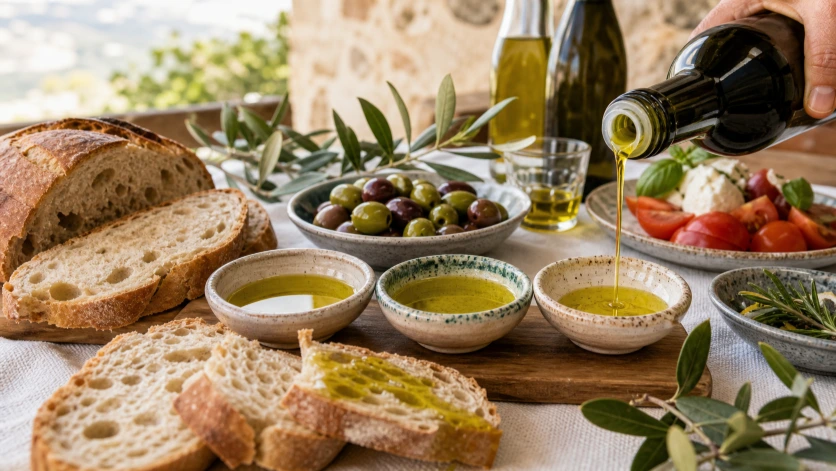
Most people use olive oil every day without really tasting it.
They pour it on salad, cook with it, dip bread into it, buy a bottle because the label looks rustic, and assume that if it says “extra virgin,” it must be good.
I understand. Olive oil seems simple.
But in Sicily, olive oil is not a background ingredient. It is one of the ways the land speaks. It can be grassy, bitter, peppery, soft, fruity, green, round, sharp, or tired. Yes, tired. Oil can taste tired, and once you learn that, you never forget it.
An olive oil tasting in Palermo or in the Sicilian countryside is not only for experts. It is for anyone who wants to understand why one oil makes bread taste alive and another one just makes it wet.
Let me show you how to taste Sicilian extra virgin olive oil, what to notice, and how to choose an experience that teaches you something real.
First, forget the bread for a moment
I know. Bread and olive oil together are one of life’s easiest pleasures.
But if you want to taste olive oil properly, start without bread.
Bread softens everything. It absorbs bitterness, hides defects, and makes even an ordinary oil feel pleasant. That is fine when you are eating. It is not enough when you are learning.
In a proper tasting, you usually taste the oil alone first. A small amount in a cup. You warm it gently with your hands. You smell it. Then you sip a little and let it move through your mouth.
This may feel strange the first time. People laugh. They look suspicious. Someone always says, “Am I really drinking oil?”
Yes, a little. Not a glass. Just enough to understand it.
After that, bread, tomatoes, cheese, vegetables, or other food pairings make much more sense because you know what the oil is doing.
What good extra virgin olive oil should smell like
Before you taste, smell.
Good extra virgin olive oil should smell alive. You may notice green tomato leaves, cut grass, artichoke, almond, herbs, green banana, fresh olives, or something peppery and vegetal.
You do not need to find the perfect tasting word. This is not an exam.
Ask yourself simpler questions: does it smell fresh? Does it smell green? Does it make you want to taste it?
Be careful with oils that smell flat, dusty, waxy, rancid, or like old nuts. Sometimes tourists buy oil because the bottle looks handmade, but the oil inside has already lost its voice.
In Sicily, freshness matters. Storage matters. Harvest matters. Heat and light are not friends of olive oil, no matter how beautiful the bottle looks in a sunny shop window.
Bitterness and pepper are good signs
Many people taste a good Sicilian olive oil and think something is wrong because it is bitter or peppery.
Actually, those can be very good signs.
A fresh extra virgin olive oil often has bitterness on the tongue and a peppery feeling in the throat. Sometimes it makes you cough a little. Sicilians do not panic. We smile.
That bitterness comes from healthy compounds in the oil and from the olives themselves, especially when they are harvested at the right moment. A completely flat oil with no bitterness, no pepper, and no green character may be old, mild, or simply not very interesting.
Of course, balance matters. You do not want an oil that attacks everything on the plate. But do not be afraid of character.
Sicilian food knows what to do with strong olive oil.
A Momento Patrizia
At my country house, I have watched guests taste a strong olive oil and make the same face they make when the sea is colder than expected. Surprise first. Then a little laugh.
One guest once coughed after tasting and apologized as if she had done something wrong. I told her, “No, that is the oil saying hello.”
After lunch, she poured the same oil over warm vegetables and understood it immediately. On its own it was intense. With food, it became beautiful.
That is the lesson: olive oil is not only tasted alone. It is understood at the table.
How Sicilian olive oil changes with food
An olive oil tasting becomes much more useful when you pair the oil with simple foods.
Bread shows texture and fruitiness. Tomatoes bring out sweetness and acidity. Fresh cheese softens bitterness. Grilled vegetables love a peppery oil. Beans and soups can become deeper with the right oil added at the end. Fish often wants a cleaner, more elegant oil, not one that covers everything.
This is where you learn why one bottle is not enough for every dish.
Some oils are perfect for finishing raw vegetables. Some are better with legumes. Some make caponata more alive. Some are too strong for a delicate fish but wonderful on toasted bread with oregano.
I always tell people: do not think only “good oil” or “bad oil.” Think “what does this oil want to be eaten with?”
That question changes how you cook.
Palermo or countryside: where should you taste olive oil?
You can do an olive oil tasting in Palermo, and it can be very practical.
If you are staying in the city, you do not need to lose half a day driving. A tasting in a historic home or central location lets you learn, taste, ask questions, and still have the rest of the day for markets, churches, or a slow lunch.
The countryside gives a different feeling.
When you taste olive oil near olive trees, with more space and quiet around you, the connection becomes easier to understand. The land is not an idea. It is there. You see the trees, the light, the dryness, the hills, the way agriculture shapes the rhythm of the place.
Neither is better for everyone. Palermo is better if your trip is short or city-based. The countryside is better if you want a slower, more sensory experience.
The important thing is that the tasting is guided by someone who can explain clearly, not just pour oil and say, “This is good.”
What to ask before booking an olive oil tasting
Ask how many oils you will taste.
One oil is not really a tasting. It is a sample. Tasting several oils helps you understand differences in fruitiness, bitterness, pepper, intensity, and use.
Ask whether food pairings are included. Bread is useful, but it is even better if you can taste oil with tomatoes, cheese, vegetables, or other local products.
Ask whether they explain how extra virgin olive oil is made. You do not need a technical lecture, but you should leave understanding harvest, pressing, storage, and why defects happen.
Ask if they teach you how to read a label. This is practical knowledge you can bring home immediately.
Ask where the tasting happens. A Palermo tasting and a countryside tasting create different expectations.
And ask whether the experience is private or shared. Both can work, but they feel different.
How to buy olive oil in Sicily without being fooled
A beautiful label is not enough.
Look for harvest information when possible. Look for dark glass or packaging that protects the oil from light. Ask when the oil was produced. Ask which cultivar or area it comes from if the seller knows.
Be careful with bottles displayed in direct sun. Olive oil does not enjoy being treated like a souvenir.
Taste before buying if you can. If you cannot taste, buy from someone you trust, not only from the prettiest shelf.
Also think about how you will use it. If you are taking a bottle home, choose something you will actually open. Do not save it for a mythical special occasion until it becomes old. Good olive oil is alive, and alive things do not wait forever.
Use it on vegetables, soup, fish, bread, beans, pasta, salad, even a simple plate of tomatoes. Let it work.
Olive oil, wine, and cheese belong together
In Sicily, olive oil tasting often makes sense beside wine and cheese.
Not because we need to turn every experience into too much food, although we are Sicilian, so yes, food tends to appear. But because these products explain each other.
Olive oil shows the land through trees. Wine shows it through grapes. Cheese shows it through animals, pasture, milk, and time. Together, they give you a small map of Sicily’s agriculture.
A tasting with wine, cheese, bread, tomatoes, and olive oil can teach you more than a long list of monuments if you are willing to pay attention.
You learn what bitterness does. What acidity does. What fat does. Why a tomato can taste different here. Why bread matters. Why one sip of wine changes the next bite.
This is not fancy for the sake of being fancy. It is practical. It is how Sicilian food thinks.
Who should book an olive oil tasting?
Book an olive oil tasting if you love food but want to understand ingredients more deeply.
Book it if you cook at home and want to know why your Sicilian recipes never taste quite the same.
Book it if you are tired of only eating in restaurants and want one experience that slows down the senses.
Book it if you are traveling with someone who does not want a full cooking class but still wants a food experience with substance.
It is also a good choice for a quieter day in Palermo. Not every food experience needs to be a market, a long lunch, or a full dinner. Sometimes ninety minutes of tasting carefully can change how you eat for years.
What you should leave with
After a good olive oil tasting, you should know a few things.
You should know how to smell an oil before judging it. You should understand that bitterness and pepper can be positive. You should know why light, heat, and time damage oil. You should know that different oils belong with different foods.
Most importantly, you should leave more confident.
Not snobbish. Confident.
You should be able to stand in front of a shelf, pick up a bottle, and ask better questions. You should be able to pour oil at home and notice whether it is fresh or tired. You should understand why Sicilian cooks treat olive oil with respect.
That is the value of tasting properly.
My honest advice
Do not treat olive oil as something you buy at the end of the trip because you need a gift.
Taste it while you are here. Learn from it. Let it explain the island a little.
If you are in Palermo and want a practical, sensory experience, an olive oil tasting can fit beautifully between a market morning and a quiet evening. If you have time for the countryside, even better: olive trees teach slowly.
You can read more about my Sicilian olive oil tasting in Palermo or Reitano if you want to taste different EVOO types, learn how to recognize quality, and understand how olive oil works with local food.
And if wine is calling you too, you may also like a Sicilian wine and cheese tasting in Palermo or the broader rhythm of my food experiences in Palermo.
Once you taste good Sicilian olive oil properly, you will still use it every day.
But you will not treat it as background anymore.